
I'm a veterinarian. For almost ten years I managed food plants in South and North America, where I worked on production lines, food safety and people. I didn't write code.
A few months ago my family and I left my dream job in Florida and moved to Switzerland. I had no job lined up and no strong backup plan. Actually, no plan at all, just to cross the ocean and start a new life in the Alps. Somewhere between the boxes and the Swiss paperwork, I started building an app.
And now it's almost ready for testing. But if I don't know how to code, how am I building apps and designing software? Let me try to explain.
What "vibe coding" means
You might have heard the phrase "vibe coding." It sounds like a joke, but the idea is simple: you describe what you want in normal language, and an AI writes the code for you.
You don't type function or worry about where the brackets go (what are those for, anyway?). You say something like: "I want a screen where I type what I spent today and it shows how much I have left this month." The AI writes it, and you run it to see what happens. When something looks wrong, you tell it what's wrong, the way you'd explain a problem to a coworker.
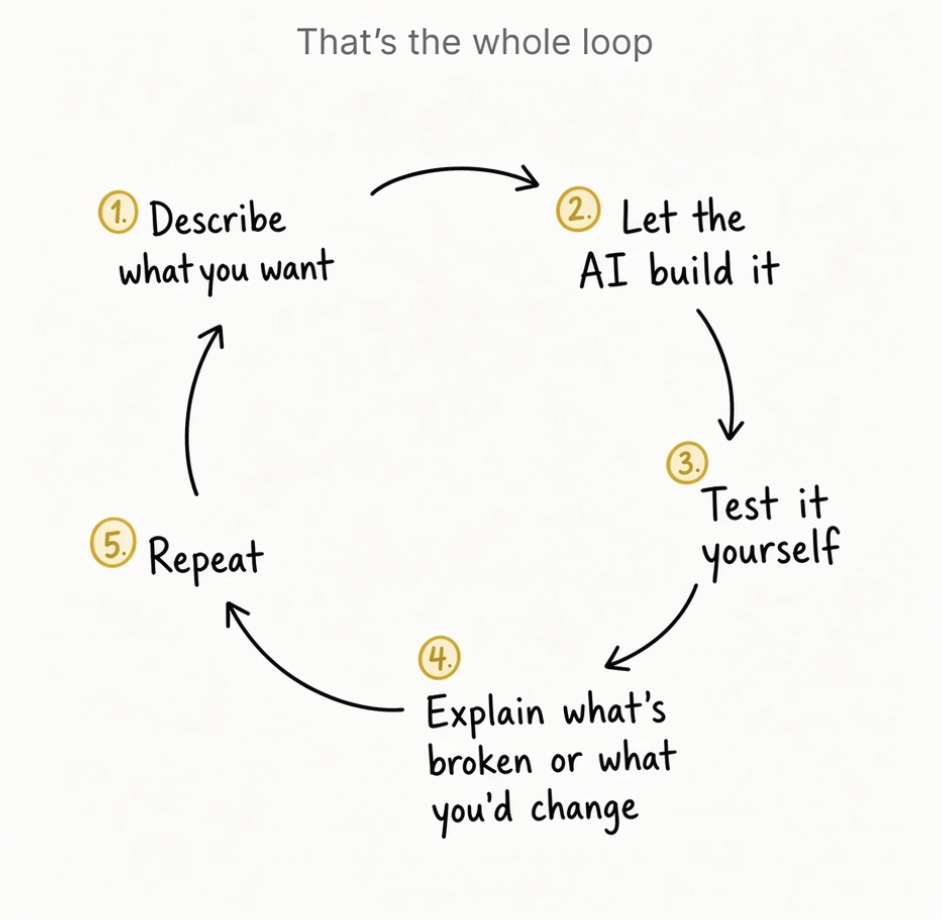
That's the whole loop:
- Describe what you want.
- Let the AI build it.
- Test it yourself.
- Explain what's broken or what you'd change.
- Repeat.
What it actually felt like
It wasn't magic. The first versions were ugly, buttons did nothing, and sometimes the AI fixed one thing and broke two others.
But it felt familiar. My everyday job was like this: something isn't working, you find out why, you explain the fix clearly, and you check that it really got fixed. It turns out that's a big part of building software with AI too. My job wasn't to know the code. It was to know what I wanted and to keep testing and learning until I got it.
What I learned (so you don't have to)
- Be specific. "Make it look better" gets random results. "Make the button blue and put it at the bottom of the screen" gets what you asked for.
- Go in small steps. Ask for one feature, test it, then ask for the next. Big requests make big messes. Believe me, really big messes.
- Test everything yourself. The AI will happily tell you it works. Check anyway. Test it a couple of times, and ask others to test it too.
- Save working versions. When something works, save it before you change anything. You'll thank yourself later (high five).
- It's okay not to understand every line. You do need to understand what the app should do and how it should feel.
The honest part
AI didn't make me a programmer. It made me a builder, which is a little different. There are still things I don't understand, and I ask a lot of "why did this break?" questions. Some days I make progress, and some days I go in circles, end up with a big headache, and wonder why I'm even doing this.
Still, an idea that would have stayed in my notes app is now something I can hold on my phone. For someone starting over in a new country, with new languages to learn, that matters.
Where this gets confusing
While I was building, I kept running into words that everyone online seems to already know: chatbot, assistant, agent. Is ChatGPT an agent? Is the thing writing my code a chatbot? I use all three now, every day, and for a long time I couldn't have told you the difference.
So that's the next post: chatbot vs. assistant vs. agent, in plain English. It'll make everything I just described make a lot more sense.
See you there.
— The Early Commit